大暗室 (Daianshitsu, The Great Darkroom, 1938) is a thriller by EDOGAWA Rampo (江戸川乱歩). I've not read any of his novels except for a couple of children's adventures, The Fiend with Twenty Faces (1936) and The Boy Detectives' Club (1937). Rampo's writing has quite a range, including children's stories, classical detective stories and "erotic grotesque" stories, which vary in tone from satire to horror.
I don't know where The Great Darkroom belongs in all this, but it's basically an adventure story with a supervillain and a righteous hero combatting him. In many respects it's very similar to the children's stories I mentioned above; but there is quite a lot that would not be acceptable in a children's book, to put it mildly. While in those the antagonist is above spilling blood, the villains in this readily murder women, children and innocent bystanders. There are occasional scenes of sadism, including sexual threats and threats of torture. A small child tortures a puppy in the prologue. The mix of horror and adventure elements is similar to many comics aimed at older children (of the kind that used to attract congressional investigations in America); and it is easy to imagine the readers of the children's stories graduating to this as they become teenagers, but probably without their parents' approval. Apparently there is a rewriting of the book (made after Rampo's death) in the Boy Detective's Club children's series, with AKECHI Kogorou vs. the fiend with twenty faces. Presumably the more offensive elements will have been removed as well.
The first section of the book is a long prologue set twenty odd years before the main events. Adventuring baron ARIAKE Tomosada (有明友定), his friend OOSONE Gorou (大曽根悟郎) and his servant Kurusu (久留須) are adrift in a lifeboat after escaping from a sinking ship. Sure that he will not survive Ariake writes a letter to his wife asking her to marry Oosone, who he hopes will look after her if she becomes a widow. When they spot land unexpectedly, Oosone, who has kept two bullets for his pistol, takes the opportunity to marry a rich and beautiful widow by shooting the other two passengers. A few years later they are married with two children, Ariake's son Tomonosuke (友之助), born after his last departure from his wife, and Oosone's infant son Ryuuji (竜次), who seems to have inherited his father's evil nature. When Kurusu unexpectedly returns from the dead, Oosone attempts to kill the whole household while making his escape with the family's transferable wealth and his son. But Kurusu again survives, though horribly disfigured by fire, along with Tomonosuke, whom he raises in secret to be the righteous avenger of his parents.
With that we move forward to present day Japan where two young men, going by the names ARIMURA and OONOKI, have won a great reputation for their varied ability and daring. When they meet, unaware of each other's true identity, they become a kind of friendly enemies. As Ryuuji starts setting his megalomaniac plans into action, Tomonosuke is there to combat him, mostly with mixed success, so that the villain gets away each time.
The book is much more interested in its villain than its hero. Like a Bond villain, Ryuuji has a vast underground base of interconnected caverns; and the narrative stops for fifty pages towards the end of the book while he gives captive journalists a tour of his kingdom. This is both unpleasant (megalomaniac villains are not people you want to spend time with) and tedious; and I imagine the original series readers must have been wondering when they could get back to the story.
Compared to the two children's books I mentioned in the first paragraph, the plotting of some of the episodes is allowed a little more complexity, although they still work on the same principle of constant surprising reversals. In particular the kidnapping of the "prince" in an all female musical revue is written as a kind of impossible crime. The description of this theatre genre is surprisingly similar to the way that the same thing is described today in the case of the famous Tarazuka Revue, with a club of fans, all young women, devoted to the protection of their idol.
Showing posts with label crime novel. Show all posts
Showing posts with label crime novel. Show all posts
Friday, 14 April 2017

Saturday, 12 March 2016
The Man Who Climbed to Heaven
“My father and mother were honest, though poor—”“Skip all that!” cried the Bellman in haste.“If it once becomes dark, there’s no chance of a Snark—
We have hardly a minute to waste!”
(Lewis Carroll, The Hunting of the Snark)
 天に昇った男 (ten ni nobotta otoko, The Man Who Climbed to Heaven, 1994) by SHIMADA Souji (島田荘司) opens in the execution block of a Japanese prison. Like America, Japan still has capital punishment, although normally reserved for murders seen as particularly worthy of punishment (such as multiple murders). KADOWAKI Haruo (門脇春男) has been on death row for decades, while his case, uncontested on his part, proceeded up through the courts to the final judgement. But when the day of his execution arrives, Kadowaki miraculously survives and is released.
For the rest of the book we follow him as he returns to the little town in O. prefecture in northern Kyushu where the crimes he was arrested for were committed. (I imagine readers will guess that O stands for Oita. You find this kind of coy documentary style of naming from time to time in Japanese fiction; I'm not quite sure what it means.) Along the way he thinks back on the events leading up to his imprisonment. This means that most of the short book is a long series of flashbacks from his childhood through the various jobs he had in life and his failed marriage up to the actual crime.
I'm not very fond of flashback narrative in any case; and when it takes up most of the book, my tolerance gets even thinner. As we approach the end, the possible surprises in the narrative are thinned out. In the end the narrative structure has its justification, of a sort, although readers may not be entirely surprised to find that it is a version of storytelling's second most hated narrative idea.
Sunday, 13 December 2015
The Hunter
NONAMI Asa's 凍える牙 (kogoeru kiba, Freezing Fang, 1996) is the first in a series of books featuring the policewoman OTOMICHI Takako (音道貴子) and one of her most successful works. It won the Naoki Prize and was adapted twice into a television series (in 2001 and 2010) and more recently into a Korean film, Howling (2012). It is also one of the few Japanese crime novels with an English translation, as The Hunter by Juliet Winters Carpenter (2006).
Japan probably has the world's highest proportion of fictional female police detectives to real ones. The majority of Japanese policewomen are in the traffic division, which is where the main character here also started, before transferring first to a motorcycle squad (used primarily for publicity purposes) and then finally to criminal investigation. In this mystery she is the only woman in the large investigating team, and is often made uncomfortably aware that she is an unwelcome presence for some of her colleagues. Worst of all, she is teamed up with one of the most prejudiced, the grumpy middle aged TAKIZAWA (滝沢), who spends the first days of the investigation ignoring her as far as possible. Gradually over the course of the case, he begins to understand her a little better.
The police procedural aspect of the story probably sounds very familiar. Mismatched partners gradually learning to work together and female police officers coping with prejudice have both been a staple of western television drama since at least the eighties. Mixing rather oddly with this generically familiar character arrangement and the realistic depiction of a police department, the crimes they investigate are fantastic and bizarre. The first victim is killed with an incendiary bomb attached to his belt, which explodes while he is eating in a Tokyo "family restaurant", burning him alive and destroying the restaurant and several storeys in the same building. Another victim is killed by a dog; and the bite marks on his killer are the same as a bite on the leg of the first victim. Apparently someone has trained a wolf-husky hybrid to kill.
The content of the crimes is not only stylistically jarring in its mismatch with the realism of the police investigation, it is also unconvincingly plotted. Even granting the unusual elements there is too much coincidence and too many aspects that don't really make sense. In this it is a little like MATSUMOTO Seichou's strangely successful 砂の器 (suna no utsuwa, 1974, translated as Inspector Imanishi Investigates, 2003), though Nonami's book is at least a little more solidly plotted than that.
The strength of the book lies not in the mystery, but in the depiction of the characters. Although a description of Otomichi and Takizawa sounds hackneyed, on the page they come across as convincingly and interestingly human. The narration switches between their viewpoints and that of witnesses or victims of the unfolding series of crimes.
Japan probably has the world's highest proportion of fictional female police detectives to real ones. The majority of Japanese policewomen are in the traffic division, which is where the main character here also started, before transferring first to a motorcycle squad (used primarily for publicity purposes) and then finally to criminal investigation. In this mystery she is the only woman in the large investigating team, and is often made uncomfortably aware that she is an unwelcome presence for some of her colleagues. Worst of all, she is teamed up with one of the most prejudiced, the grumpy middle aged TAKIZAWA (滝沢), who spends the first days of the investigation ignoring her as far as possible. Gradually over the course of the case, he begins to understand her a little better.
The police procedural aspect of the story probably sounds very familiar. Mismatched partners gradually learning to work together and female police officers coping with prejudice have both been a staple of western television drama since at least the eighties. Mixing rather oddly with this generically familiar character arrangement and the realistic depiction of a police department, the crimes they investigate are fantastic and bizarre. The first victim is killed with an incendiary bomb attached to his belt, which explodes while he is eating in a Tokyo "family restaurant", burning him alive and destroying the restaurant and several storeys in the same building. Another victim is killed by a dog; and the bite marks on his killer are the same as a bite on the leg of the first victim. Apparently someone has trained a wolf-husky hybrid to kill.
The content of the crimes is not only stylistically jarring in its mismatch with the realism of the police investigation, it is also unconvincingly plotted. Even granting the unusual elements there is too much coincidence and too many aspects that don't really make sense. In this it is a little like MATSUMOTO Seichou's strangely successful 砂の器 (suna no utsuwa, 1974, translated as Inspector Imanishi Investigates, 2003), though Nonami's book is at least a little more solidly plotted than that.
The strength of the book lies not in the mystery, but in the depiction of the characters. Although a description of Otomichi and Takizawa sounds hackneyed, on the page they come across as convincingly and interestingly human. The narration switches between their viewpoints and that of witnesses or victims of the unfolding series of crimes.
Wednesday, 4 November 2015
My Town
NONAMI Asa (乃南アサ, born 1960) is probably best known for her books with police detective OTOMICHI Takako (音道 貴子). The first of those, 凍える牙 (kogoeru kiba, Frozen Fang, 1996) even has an English translation (The Hunter, translated by Juliet Winters Carpenter, 2006). ボクの町 (boku no machi, My Town, 1998) is less well known. It's not a detective story, not even a crime novel really, though the narrative includes several crimes. It's the account of one trainee policeman's first apprentice year in a local police mini station (a kouban) in Tokyo.
The young policeman TAKAGI Seidai (高木聖大) is a bit of a misfit in the police world. He has no great natural enthusiasm for the job and would rather be chasing girls. He had left university with no clear idea what he wanted to do and joined the force almost randomly. Even on his first roll call he gets marked out by his superior officers for having a sticker with a photo of his last girlfriend stuck in the back of his police notebook. He still has an ear piercing, and his speech is mostly casual and slangy. (It sounds like the dialect typical of thoughtless slapdash young men in television dramas, the 'su style, you could say; I've never heard this in real life, and don't know if it's a convention or a real thing.) Through his post training apprentice year he gets experience of what the work really demands, often failing to live up to expectations and questioning whether he has made the right choice in joining the police.
The uniformed police don't get much attention in fiction in Japan or the English speaking world, so it's interesting to read a bit about them for a change. The mini police stations in particular are a very Japanese institution. Tourist guides to Japan often advise you to ask for directions there. There aren't enough of them for that to be actually practical for a tourist; but from the novel it seems that giving directions really is a major part of the work. There are crimes too; but they aren't necessarily resolved. As policemen on the beat, the characters have less control over how things work out than a detective. Mostly they can only patrol or wait and hope to run into the criminal. Towards the end, though, a serial arsonist changes the narrative expectations, as Takagi joins the all out hunt to catch the culprit.
The young policeman TAKAGI Seidai (高木聖大) is a bit of a misfit in the police world. He has no great natural enthusiasm for the job and would rather be chasing girls. He had left university with no clear idea what he wanted to do and joined the force almost randomly. Even on his first roll call he gets marked out by his superior officers for having a sticker with a photo of his last girlfriend stuck in the back of his police notebook. He still has an ear piercing, and his speech is mostly casual and slangy. (It sounds like the dialect typical of thoughtless slapdash young men in television dramas, the 'su style, you could say; I've never heard this in real life, and don't know if it's a convention or a real thing.) Through his post training apprentice year he gets experience of what the work really demands, often failing to live up to expectations and questioning whether he has made the right choice in joining the police.
The uniformed police don't get much attention in fiction in Japan or the English speaking world, so it's interesting to read a bit about them for a change. The mini police stations in particular are a very Japanese institution. Tourist guides to Japan often advise you to ask for directions there. There aren't enough of them for that to be actually practical for a tourist; but from the novel it seems that giving directions really is a major part of the work. There are crimes too; but they aren't necessarily resolved. As policemen on the beat, the characters have less control over how things work out than a detective. Mostly they can only patrol or wait and hope to run into the criminal. Towards the end, though, a serial arsonist changes the narrative expectations, as Takagi joins the all out hunt to catch the culprit.
Tuesday, 21 July 2015
The Great Kidnapping: Rainbow Kids

Three young small time crooks leave prison planning to make some real money. The leader Kenji (健次) is thinking of a kidnapping, to the alarm of the others, who remember horrible news stories of child kidnappings gone wrong. No, he assures them, the target is not a child, but an old woman, YANAGAWA Toshiko (柳川とし子, known as Toji, apparently an old fashioned honorific for a woman running the affairs of a wealthy family). She is the head of a Wakayama family that controls a vast extent of forest land. Unknown to the kidnappers, they have picked an ideal time, as she has taken it into her head to go for a walk every day through a different part of the Yanagawa lands, accompanied only by her maid Kimi.
When the kidnappers, after various misadventures, finally succeed in capturing her, it immediately becomes clear who is going to be in control, when she insists on them letting Kimi go. Soon, instead of heading to the hideout they had prepared, they are staying on the farm of one of Toshiko's loyal former servants. Their plans are thrown out much more drastically, when she hears how little (in her opinion) they were planning to ask for ransom. She insists on a huge sum, far greater than any previous ransom; and the gang agree, very unwillingly (how are they even going to carry a sum like that). Soon the case developes into a game of wits between the old lady directing the gang behind the scenes and the wily police chief, who had got his start in life from Toshiko's support when he was a child, and is fiercely devoted to her. As each side challenges the other, the whole of Japan and the world outside are drawn into the spectacle.
This is not a black comedy. There is no violence and no real villains. Most of the characters rise to the challenges presented them. The humour is mostly in the characters (particularly Toshiko, always gentle and courteous, but sure to get her way) and the situation, not so much in actual jokes or comedy set pieces. The tricks that the kidnappers use to outwit the police are reminiscent of the "caper" style of crime file (like Ocean's Eleven), but the book also reminds me a bit of earlier comedy adventures like John Buchan's John Macnab.
The film is very close to the book, in both substance and tone. The main differences are only simplifications and minor omissions. Occasionally a scene is very slightly more slapstick than the book, but this is rare. One minor difference of tone is the music. Okamoto sets a lot of scenes to upbeat pop music; and this sounds a lot more like 1990 than 1979 to me. It's no classic, but I thought it was a very successful adaption, definitely worth seeing if you get the chance.
Thursday, 14 May 2015
Marks' Mountain
マークスの山 (Maakusu no yama, Marks' Mountain, 1993) by TAKAMURA Kaoru (高村薫, born 1959) won the Naoki prize, a major Japanese prize for popular literature, in 1993. It was made into a film with the same title (but apparently given the title Marks when shown in America), directed by SAI Youichi (崔洋一), in 1995 and a television series in 2010. It's a long book, about 720 pages in bunko format, split up into two volumes; and its ambitious story runs from 1977 to 1992.
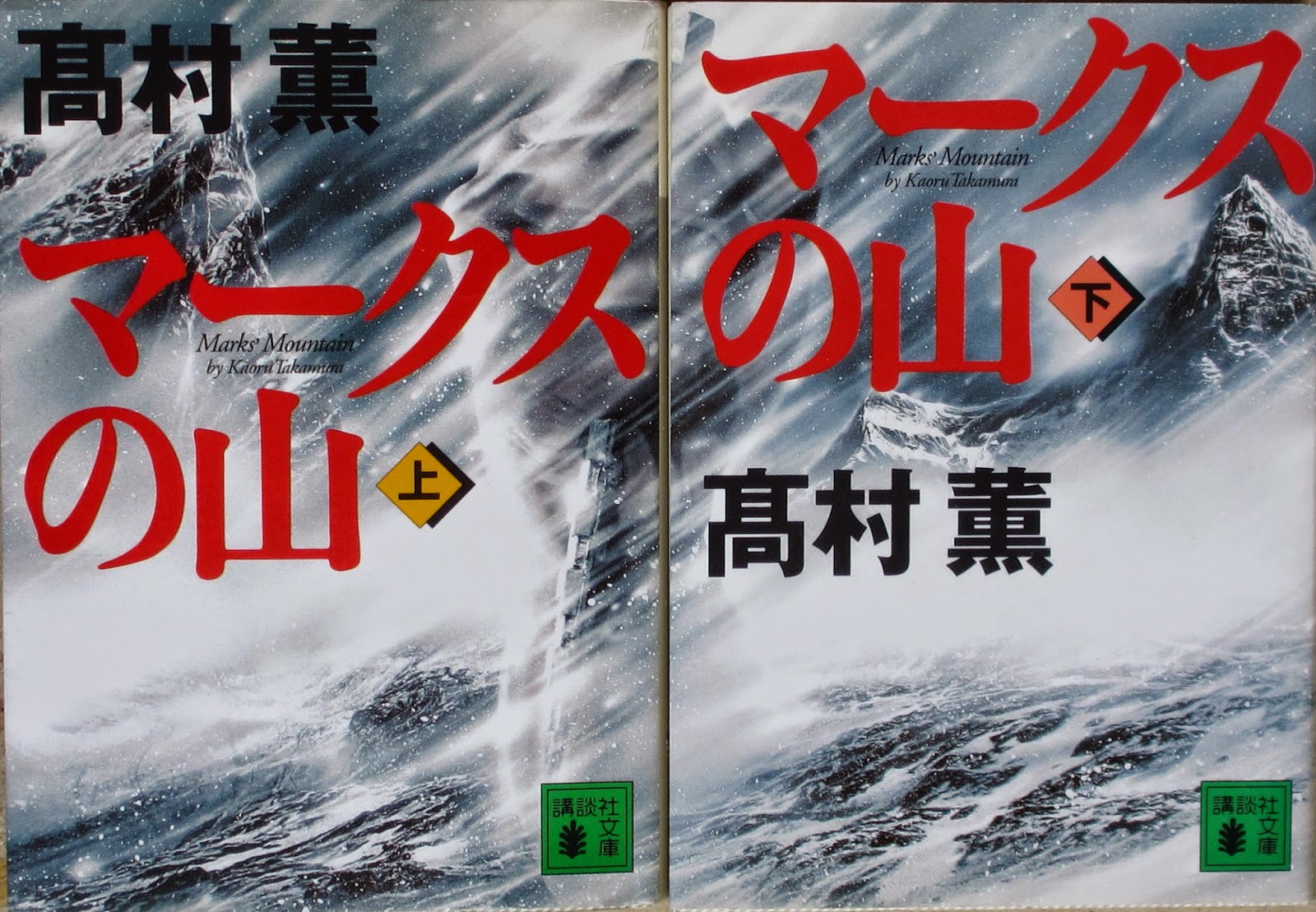
The start of the story is a killing near Kitadake in the Japanese Alps. The killing is no mystery. A drunk living in the hills had hallucinated a wild animal and beat it to death, then woken the next day to find the dead body of a climber. The police close the case, leaving as an unsolved mystery what had brought the victim to his killer's door in the middle of the night. A few days earlier in the same area, a young boy had escaped from an attempt at family suicide on the same mountain. His surviving relatives take him in, but he has suffered brain damage from carbon monoxide poisoning. It is only in 1989 that another body is discovered, a skeleton on the mountain above where the first victim had died. Four years later in Tokyo, a series of brutal murders seem to have some connexion to the killings in the mountains. Different investigations in different parts of the city gradually come together, pursuing the boy from the suicide attempt and a group of now influential former students, who had been in a university mountain climbing club back in the seventies.
The story is a kind of police procedural, and although there are elements of mystery, we get to the answers in the course of the investigation rather than finding them for ourselves. We follow various points of view, including the killer; but the great majority is seen through the eyes of a Tokyo policeman, GOUDA Yuuichirou (合田雄一郎). There is a lot of internal politics in the story, as the different parts of the police and the public prosecutors fail to cooperate with each other. A lot of the narrative is taken up with meetings or with travelling to and fro across Tokyo by taxi or underground. I don't find either meetings or travelling by underground very exciting, so there were times when I thought that the story could easily have been a couple of hundred pages shorter. But it has perhaps the cumulative effect of letting us share almost every moment of Gouda's investigation, as he and the rest of the team pursue every possible link, often catching just a couple of hours sleep at the police station before starting again. Despite the emphasis on detail, the story is not conventionally realistic, building the plot around a large number of coincidences (or the work of destiny, as the investigating detectives call it towards the end of the book). You could see it as an attempt to write the police procedural as an epic, a tragic one, with many victims either of their own bad decisions or of cruel accidents of life.
The start of the story is a killing near Kitadake in the Japanese Alps. The killing is no mystery. A drunk living in the hills had hallucinated a wild animal and beat it to death, then woken the next day to find the dead body of a climber. The police close the case, leaving as an unsolved mystery what had brought the victim to his killer's door in the middle of the night. A few days earlier in the same area, a young boy had escaped from an attempt at family suicide on the same mountain. His surviving relatives take him in, but he has suffered brain damage from carbon monoxide poisoning. It is only in 1989 that another body is discovered, a skeleton on the mountain above where the first victim had died. Four years later in Tokyo, a series of brutal murders seem to have some connexion to the killings in the mountains. Different investigations in different parts of the city gradually come together, pursuing the boy from the suicide attempt and a group of now influential former students, who had been in a university mountain climbing club back in the seventies.
The story is a kind of police procedural, and although there are elements of mystery, we get to the answers in the course of the investigation rather than finding them for ourselves. We follow various points of view, including the killer; but the great majority is seen through the eyes of a Tokyo policeman, GOUDA Yuuichirou (合田雄一郎). There is a lot of internal politics in the story, as the different parts of the police and the public prosecutors fail to cooperate with each other. A lot of the narrative is taken up with meetings or with travelling to and fro across Tokyo by taxi or underground. I don't find either meetings or travelling by underground very exciting, so there were times when I thought that the story could easily have been a couple of hundred pages shorter. But it has perhaps the cumulative effect of letting us share almost every moment of Gouda's investigation, as he and the rest of the team pursue every possible link, often catching just a couple of hours sleep at the police station before starting again. Despite the emphasis on detail, the story is not conventionally realistic, building the plot around a large number of coincidences (or the work of destiny, as the investigating detectives call it towards the end of the book). You could see it as an attempt to write the police procedural as an epic, a tragic one, with many victims either of their own bad decisions or of cruel accidents of life.
Monday, 30 March 2015
Eugenia
ユージニア (Eugenia, 2005) by ONDA Riku (恩田陸) won the Mystery Writers of Japan Award in 2006. The book describes a mass poisoning and its aftermath over several decades.
The family of a respected doctor in the Hokuriku town of K (which doubtless stands for Kanazawa) are celebrating a major family anniversary. A motorcycle delivery man brings alcohol and juice, saying that it is sent by an old friend of the doctor. When the family and visiting neighbours drink a toast together, all of them, including several children, die, leaving only a servant and the daughter of the family, blind middle school student Hisako.
Ten years later, one of the children who discovered the mass murder, Makiko, then in junior school, now a student, interviews those witnesses she can find about the crime. Her researches result in a book, The Forgotten Celebration, which becomes a bestseller. The book, though, has some oddities that might make you wonder what her aim in writing it was. Now, decades after that book, someone is interviewing the surviving witnesses again. Most of the chapters are a dialogue with one voice (the interviewer's) removed. A few chapters are internal monologues of characters from the present or the past, or told by an external narrator.
As the various narrators contribute, it becomes clear that most people suspect the blind Hisako of having engineered the massacre. The story becomes a kind of horror story, filling the reader with unease about what Hisako, Makiko, and the unseen interviewer are looking for. The story has 'clues' of a sort, marked bits of the narrative which are obviously going to be explained later; but the explanations when they came seemed fairly abritrary (that is I felt the writer could have spared us the clue).
In my case much of the unease was a suspicion that the story was not going to make any sense. And did it? I don't really know, to be honest. The book was something of a struggle to read; and I had lost interest long before the end. Neither the characters nor the narration were really vivid; most were dreamlike, half sedated. The format, in which we frequently switch between speakers, without an indication of the change, was probably more demanding for me, since as a language learner I miss a lot of the subtler clues that a Japanese speaker would pick up on.
The family of a respected doctor in the Hokuriku town of K (which doubtless stands for Kanazawa) are celebrating a major family anniversary. A motorcycle delivery man brings alcohol and juice, saying that it is sent by an old friend of the doctor. When the family and visiting neighbours drink a toast together, all of them, including several children, die, leaving only a servant and the daughter of the family, blind middle school student Hisako.
Ten years later, one of the children who discovered the mass murder, Makiko, then in junior school, now a student, interviews those witnesses she can find about the crime. Her researches result in a book, The Forgotten Celebration, which becomes a bestseller. The book, though, has some oddities that might make you wonder what her aim in writing it was. Now, decades after that book, someone is interviewing the surviving witnesses again. Most of the chapters are a dialogue with one voice (the interviewer's) removed. A few chapters are internal monologues of characters from the present or the past, or told by an external narrator.
As the various narrators contribute, it becomes clear that most people suspect the blind Hisako of having engineered the massacre. The story becomes a kind of horror story, filling the reader with unease about what Hisako, Makiko, and the unseen interviewer are looking for. The story has 'clues' of a sort, marked bits of the narrative which are obviously going to be explained later; but the explanations when they came seemed fairly abritrary (that is I felt the writer could have spared us the clue).
In my case much of the unease was a suspicion that the story was not going to make any sense. And did it? I don't really know, to be honest. The book was something of a struggle to read; and I had lost interest long before the end. Neither the characters nor the narration were really vivid; most were dreamlike, half sedated. The format, in which we frequently switch between speakers, without an indication of the change, was probably more demanding for me, since as a language learner I miss a lot of the subtler clues that a Japanese speaker would pick up on.
Saturday, 31 January 2015
The Reason
 I need a new label for this. Most of the crime fiction I write about here can be categorised as detective stories. My own preference is fairly strongly for the more puzzle oriented books; but I don't expect that everything that I read should have Ellery Queen style formal proof of the culprit. 理由 (riyuu, The Reason, 1998) by MIYABE Miyuki (宮部 みゆき), which won the Naoki Prize (one of Japan's major prizes for popular literature), is not really written as a mystery. There are things we don't know at the start of the story that we learn as it goes on; but the narrative does not invite us to try and puzzle too much about what is going on. I've tagged this post as "crime novel". Of course most detective stories are crime novels too; but I'll reserve the label for posts about books which can't be read as mysteries.
I mentioned Miyabe's interesting approach to narration when I wrote about The Long Long Murder (長い長い殺人). The Reason is not so unusual; but it still shows an interest in how to tell a story. The crime that the book describes is the violent death of four people in an apartment high up in a luxury block of flats. It soon becomes clear that the victims are not the owners that the building's administration have on their books; and the police realise that they have no idea who has died or why. The story's narrator presents most of the book as if reporting a now solved actual crime, with the limited viewpoint that that entails. The narrator is not very present in the narrative, but gives a tapestry of second hand accounts of the various witnesses and incidentally involved characters. Occasionally we get a little more involved with a description of an interview with a major character. And then, in contrast to this documentary style, we also get a few chapters which are narrated (as if by an omniscient narrator) from the viewpoint of one or another character. These sections are more conventionally novelistic, though the reader might suppose that they too came from a non fiction writer, choosing to write in a more novelistic way. The documentary style majority of the book also implies a readership slightly different from the real readership. Living in the world in which the crime was a major media event, they presumably know more than we do about what happened. For us the crime is a mystery. Finding out exactly what happened and why is not so much a matter of investigating, as waiting for the narrator to get to that part of the account.
You'll often read descriptions of the history of Japanese detective fiction which implies a sort of war between puzzle detective stories and social detective stories, with MATSUMOTO Seichou driving out the puzzles in the fifties and sixties, until the "new orthodox" detective story brought back the puzzle under the leadership of AYATSUJI Yukito (綾辻 行人) in 1987. I haven't read enough to say this is complete nonsense; but I feel confident that it's fairly misleading. Matsumoto wrote so many books that he almost counts as a school in his own right; but those I've read, while clearly concerned with describing the way the world is now, also have a strong puzzle element. And what was the rest of the "social school"? "Society" is not the central interest of almost any of the other writers from the seventies and eighties that I have read, even if the puzzle was not central either. Traditional themes like the impossible crime have always been popular enough in Japan that it is no surprise when one meets such a trick in almost any crime novel. That said, The Reason lives up to the stereotype of the "social school", as far as a book can.
Towards the beginning, it looks like the theme of the book is going to be "real estate in the post bubble economy". Many of the early chapters and middle chapters are concerned with the dubious finance and not quite legal practices in the buying and selling of property in Japan's depressed economy. Gradually it becomes clear that this is part of a larger focus. As we meet with different groups of people concerned in the case, we realise that the theme is not so much "real estate" as "making a home"; most people who buy a house or flat, do so to raise a family. We meet various families and hear their stories. Some are getting along well , others are just managing to hold together, or breaking apart. And we also see people who have left their families for various reasons.
In the end the book seems to favour a particular view on the way society is going. It does so only through opinions expressed by the characters; but the narrator does not offer a divergent opinion either in their own voice or from another character. It's a view that I look at with some scepticism, as I feel it forgets that the world that young people are growing up in is changed by circumstances over which they had no choices. Some things are possible for them that were not possible for their parents. Other things that were easy for their parents are harder for them (here I am thinking particularly of their financial situation). This is obviously true in Europe. I know that Japan has not changed as much; but I think the same trends are there.
The book is one of the longer ones that I have read, over 670 pages. That would be a little shorter in a typical western paperback format (Japanese paperback pages are small, but densely printed); but it would still be a long book. If that doesn't discourage you, and if your interest in crime fiction goes beyond mysteries or suspense, then it is certainly worth trying. Despite the length, it had no trouble in holding my interest.
Subscribe to:
Posts (Atom)